1) Where will you publish your ad? Why did you choose that source?
I will publish on the internet and my source was www.apple.com and you can see the tutorial video to know how use this cellphone (the name of the cellphone is new special phone 1.0)
2) What is the message that you transmit?
All the persons can use this cellphone, disabled peoples can feel like de rest.
3) Who will be your target audience? ....
Was from disabled peoples for any age, this cellphone was so fast and you can talk with him, and for the peoples that are disabled has a %of discount and more preferences.
4) What stereotype will you use? Why will you use it? What does this stereotype represent?
The stereotype I use for disabled peoples and represent Don Francisco of the teleton, this type of stereotype represent that all peoples can use this cellphone ( boys, girlds, granfather, disabled peoples, etc). Use it because with this you can do what ever you want.
5)...
Would be Ethos because he sample and offers the product was a famus people, buinessman and a successful on the topic of disabled.
I choose because this peoples has to updated and have entertainment.
Was present like a good moment.
6)...
Slogan: Was for all the type of person.
I put Don Francisco in the teleton with a disabled boy and Don Francisco give to him a phone that are the new special phone 1.0 ad layout.
"here was the last of tecnology"
"one of the most important thing in the present (actuality)
and the mode of persuation ethos
lunes, 24 de marzo de 2014


miércoles, 27 de noviembre de 2013
blog tattoos
1)Caption:
I have been rejacted in many job interviews, even before they know about my vast expirience
2) Picture

3) What you lermnt in class
I lernt that tattos can be special for everybody
4) Paragraph 1 (discrimination)
Source: www.vutrailblazer.info
This discrimination is centred on employers or applicants with body modifications such as tattoos.
5) Paragraph 2
Source: www.mookychick.co.uk
Many people are apprenhisive about getting their first tattoo.
*5) My opinion
It all depends on my family my ansestors, if forced to continue the tradition or if I can do what I want, and then if a person try to discriminate me I will ignore, turn around and leave. I have a good opinion of this because as far as I know the traditions do not break and would be very bad break.
6) three important ideas
I have been rejacted in many job interviews, even before they know about my vast expirience
2) Picture
3) What you lermnt in class
I lernt that tattos can be special for everybody
4) Paragraph 1 (discrimination)
Source: www.vutrailblazer.info
This discrimination is centred on employers or applicants with body modifications such as tattoos.
5) Paragraph 2
Source: www.mookychick.co.uk
Many people are apprenhisive about getting their first tattoo.
*5) My opinion
It all depends on my family my ansestors, if forced to continue the tradition or if I can do what I want, and then if a person try to discriminate me I will ignore, turn around and leave. I have a good opinion of this because as far as I know the traditions do not break and would be very bad break.
6) three important ideas
- First I talk about my caption and what are the meaning of this picture
- Then explain the discrimination of tattoos
- Finally that the more important thing is what my family say.
lunes, 11 de noviembre de 2013
martes, 5 de noviembre de 2013
opinion piece "tattoos"
positive statements
"In a point of view an art"
In my opinion tattoos have nothing wrong. The only serious thing is that they can't be removed. Some peoples do it for tradition but for me it would be like art.
I like people who get tattoos of their ancestors. For me, there is no purpose to be for a special occasion the tattoo in fact it would only be for me as an tattoo artiste display.
If I had a tatto it would show as if it were an artiste display and showing it would go to the beach but for work I would wear long sleeves.
From another point of view tattoo art may be better to beseen as fashon and that would be more attractive.
I have seen those tattoos that I mentseneed before that for me were art, but for other people those tattoos were vandalism, my view of that is that it is wrong.
The younger generations are the only one that think, that tattoos accept cultured individuals but it is a slow proccess.
There are a few exeptions. In some segments of music and art, but in most cases tattoos tust do not help a person to get a job.
jueves, 5 de septiembre de 2013
iditarod race event
Iditarod History
The Iditarod Trail Sled Dog Race officially started in 1973, but the trail itself and the use of dog teams as a mode of transportation has a long and storied past. In the 1920s for example, newly arrived settlers looking for gold used dog teams in the winter to travel along the historic Iditarod Trail and into the gold fields.
In 1925, the same Iditarod Trail was used to move medicine from Nenana to Nome after an outbreak of diphtheria threatened the lives of nearly everyone in the small, remote Alaskan town. The journey was nearly 700 miles (1,127 km) through incredibly harsh terrain, but showed how reliable and strong dog teams were. Dogs were also used to deliver mail and carry other supplies to the many isolated areas of Alaska during this time and many years later.
Throughout the years however, technological advances led to the replacement of sled dog teams by airplanes in some cases and finally, snow mobiles. In an effort to recognize the long history and tradition of dog sledding in Alaska, Dorothy G. Page, chairman of the Wasilia-Knik Centennial helped set up a short race on the Iditarod Trail in 1967 with musher Joe Redington, Sr. to celebrate Alaska's Centennial Year. The success of that race led to another one in 1969 and the development of the longer Iditarod that is famous today.
The original goal of the race was for it to end in Iditarod, an Alaskan ghost town, but after the United States Army reopened that area for its own use, it was decided that the race would go all the way to Nome, making the final race approximately 1,000 miles (1,610 km) long.
alaska dog sled race
History
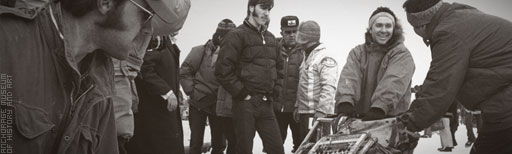
The World was Changing…
Original document by Don
Bowers, Edited 2012
Even after the advent of
the airplane, dog teams continued to be widely used for local transportation
and day-to-day work, particularly in Native villages. Mushers and their teams
played important but little remembered roles in World War II in Alaska, particularly
in helping the famous Eskimo Scouts patrol the vast winter wilderness of
western Alaska.
After the war, short and
medium distance freight teams were still common in many areas of Alaska even
when President Kennedy announced that the United States would put a man on the
moon. During the 1960′s, however, it was not space travel but the advent of the
“iron dog” (or snowmachine or snowmobile) that resulted in the mass abandonment
of dog teams across the state and loss of much mushing lore.
In 1964, the Wasilla-Knik
Centennial Committee was formed to look into historical events in Alaska,
specifically the Mananuska-Susitna Valley, over the past century. 1967 marked
the 100th anniversary of Alaska being a U.S. Territory after being purchased
from Russia. Dorothy Page, chairman of this committee, conceived the idea
of a sled dog race over the historically significant Iditarod Trail. Joe
Redington Sr. was her first real support for such a race. Joe and his
wife Vi had deep historical interests in the Iditarod Trail since the mid-1950′s
and felt this centennial race would help in their quest to preserve the
historic gold rush and mail route and get it recognized nationally. The
Redingtons and Pages joined forces. Dorothy poured her heart and soul
into research as a historian and Joe Redington worked non-stop to put together
a new sprint sled dog race.
With much volunteer labor
(the start of a fundamental Iditarod tradition), the first part of the trail
was cleared, including nine miles of the Iditarod Trail. The two heat, 56
mile Centennial race between Knik and Big Lake was held in 1967 and 1969.
Then, interest in the race was lost. However, Joe Redington never lost
interest, instead his vision grew into a never conceived of before long-distance
race. Countless hours of discussions with fellow mushers followed.
Two of these mushers were teachers, Tom Johnson and Gleo Hyuck. These
three men spirited this first-ever, long-distance race into reality and in 1973
a new race was born. The U.S. Army helped clear portions of the trail and
with the support of the Nome Kennel Club (Alaska’s earliest, founded in 1907),
the race went all the way to Nome for the first time. Even so, the mushers
still had to break much of their own trail and take care of their own supplies.
The winner of the first Iditarod was Dick Wilmarth, taking almost three weeks
to reach Nome.
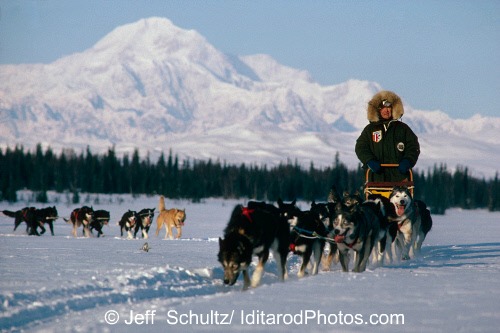
Redington had two reasons
for organizing the long-distance Iditarod Race: to save the sled dog
culture and Alaskan huskies, which were being phased out of existence due to
the introduction of snowmobiles in Alaska; and to preserve the historical
Iditarod Trail between Seward and Nome. To promote both goals, Redington
asked Dorothy Page to be the editor of an Iditarod Annual. Her
enthusiasm, drive, and love of history opened the world’s eyes to the Iditarod
Trail Sled Dog Race®.
The race is really a
reconstruction of the freight route to Nome and commemorates the part that sled
dogs played in the settlement of Alaska. The mushers travel from checkpoint to
checkpoint much as the freight mushers did eighty years ago—although some
modern dog drivers like Doug Swingley, Martin Buser, Jeff King, Susan Butcher,
and Rick Swenson move at a pace that would have been incomprehensible to their
old-time counterparts, making the trip to Nome in under ten days.
Since 1973, the
race has grown every year despite financial ups and downs. The Iditarod has
become so well-known that the best mushers now receive thousands of dollars a
year from corporate sponsors. Dog mushing has recovered to become a
north-country mania in the winter, and some people now make comfortable livings
from their sled-dog kennels.
Suscribirse a:
Entradas (Atom)